


Qingdao Today
 2026/3/3
 source:
 Print
Print
Last year, Qingdao's scientific landscape reached a new peak, with a growing and advanced laboratory system. The city now has 16 national key laboratories, one provincial laboratory, and 86 provincial key laboratories. This robust innovation network — covering basic research, applied science, and advanced technology — has become the cornerstone of Qingdao's efforts to develop new quality productive forces.
A key feature of this system is its maritime expertise. National laboratories are strategically anchored in Qingdao's oceanic resources, focusing on important sectors like mariculture bio-breeding, sustainable production, marine food processing, and safety control. These facilities provide the necessary research infrastructure to maintain the city's global leadership in marine science.
The success of this network lies in its integrated University + Research Institute + Enterprise model. Leading academic institutions, including Shandong University and Ocean University of China, offer theoretical foundations and talent in fields like next-generation IT and health sciences.
At the same time, specialized institutes like the Qingdao Institute of Bioenergy and Bioprocess Technology, Chinese Academy of Sciences, connect basic research and practical application.
Market leaders such as Haier and Hisense ensure that research remains demand-driven. By co-developing R&D teams, these partners are commercializing breakthroughs.
This collaborative ecosystem effectively aligns academic resources with industrial needs, turning scientific potential into tangible economic growth and strengthening Qingdao's position as a modern technology powerhouse.
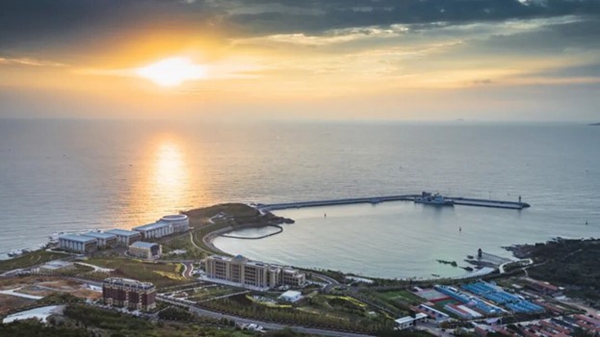
An aerial view of the National Deep Sea Center based in Qingdao. [Photo/Guanhai News]
Photos
